Insights
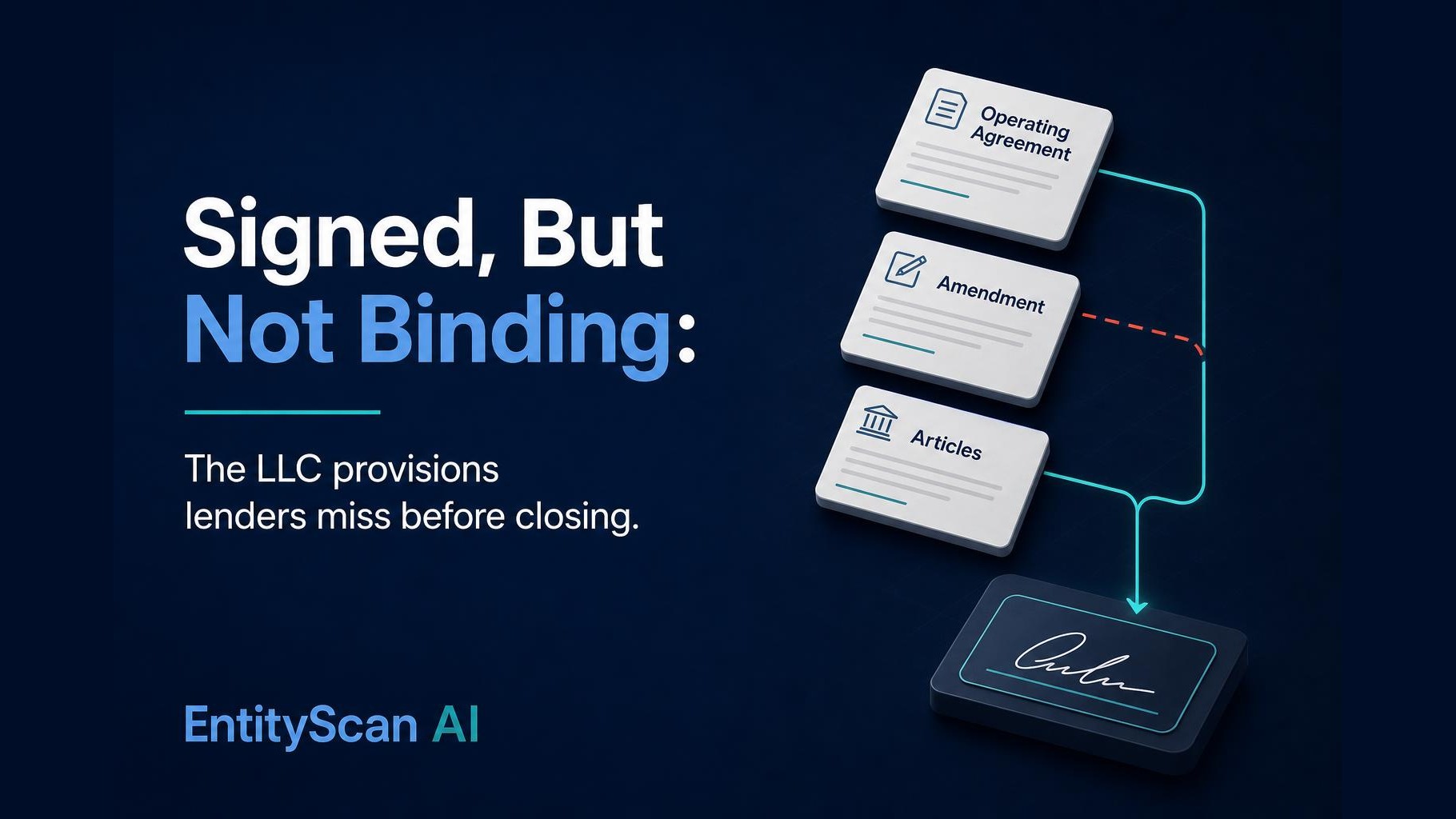
Signed, But Not Binding: The LLC Provisions Lenders Miss
When a bank, credit union, or private lender extends credit to an LLC, the loan documents are only as enforceable as the authority behind the signature on the closing documents. The borrowing LLC's operating agreement is where that authority is defined — and where the risks that derail closings tend to hide. Reviewed under deadline, these agreements are easy to skim. But a handful of provisions determine whether the people signing can actually bind the company, whether the loan requires consents you haven't collected, and whether the entity in front of you is the one described on paper. This is a practical guide to what matters in an operating agreement review before you close.
Start with the management structure
The first question is who runs the company, because it dictates who can act for it. In a member-managed LLC, the members generally have authority to bind the entity. In a manager-managed LLC, that authority sits with the manager or managers, and individual members typically cannot sign on the company's behalf. The agreement should state which structure applies, and the articles of organization filed with the state often say so as well. When the two disagree, or when the agreement is silent, treat it as a flag requiring resolution — the wrong signatory can leave you with an unenforceable obligation.
Confirm authority to borrow and grant liens
General management authority is not the same as authority to take on debt. Many operating agreements carve out borrowing, granting security interests, or encumbering company assets as decisions that require something more — member approval, a specified vote, or the consent of a particular person. Look specifically for language governing indebtedness, liens, guaranties, and the disposition of assets. If the agreement limits or conditions the entity's ability to borrow, the lender needs to know that those conditions are satisfied prior to closing.
Check the required consents and voting thresholds
Where approval is required, the agreement will usually specify the threshold: a majority in interest, a supermajority, or unanimous consent. It may also name individuals or classes of members whose sign-off is mandatory. These thresholds are easy to miss and consequential — a borrowing resolution signed by one manager means little if the agreement requires unanimous member consent to incur debt. Confirm the threshold, then confirm that the consent you have collected actually meets it.
Match signatories and titles to a real role
LLCs do not have a fixed set of officer titles the way corporations do. An operating agreement may create titles like President or CEO, may use "Manager" or "Authorized Person," or may use no titles at all. Match the person signing, and the title they sign under, to a role the agreement actually recognizes and authorizes. A signature block listing a title that does not exist in the governing documents — or a person who holds no authorizing role — is one of the most common and most avoidable defects in entity closings.
Understand ownership, control, and transfer restrictions
Knowing who owns and controls the borrower matters for diligence, beneficial-ownership requirements, and your understanding of who is really standing behind the loan. The agreement should identify the members and their percentages, and it will often restrict transfers or pledges of membership interests. If interests are pledged elsewhere, or if control can shift without your knowledge, that affects the credit. Trace ownership through any layered or parent entities rather than stopping at the first page.
Make sure it is the current version
An operating agreement is only useful if it is the operative one. Amendments, amended-and-restated versions, and side agreements can change management, authority, and ownership. Confirm you are reviewing the current agreement together with any amendments, and that no later amendment supersedes the provisions you are relying on. Closing against a superseded version is reviewing the wrong document with misguided confidence.
Remember the agreement does not prove the entity exists
Finally, the operating agreement tells you how the entity is supposed to operate — not whether it currently exists and is active in its formation state. An LLC can be administratively dissolved or delinquent while its operating agreement sits unchanged in the file. Pair the document review with a current status check in the LLC's formation state, so you are not lending to an entity that has lost its standing to do business. If the loan is secured by property in a state other than the LLC's formation state, then a status check should also be performed in the property state to assure that the LLC is registered to do business there.
A partial LLC entity review checklist
The items below are among the things that must be confirmed before closing a loan to an LLC borrower — but treat them as a starting point, not a complete list. A thorough review reaches many more provisions — ones that are easy to overlook precisely because they rarely cause trouble until they do.
- The management structure — member-managed or manager-managed — and who can bind the entity
- Specific authority to borrow and to grant liens
- The consent threshold for debt, and that the consents you collected meet it
- That the signatory, and the title they sign under, match a role the agreement authorizes
- The members, their percentages, and any transfer or pledge restrictions
- Whether the entity's stated purpose is broad enough to cover the contemplated borrowing
- Confirm that the entity's term does not expire before the loan's maturity date
- If the collateral sits in a state other than the formation state, whether the LLC is qualified as a foreign LLC in that property state
- That you are reviewing the current agreement together with any amendments, with no later amendment superseding the provisions you are relying on
- Current active status in the formation state — and the property state, if different
And that is still only part of it. Single-purpose-entity covenants, validity of signatures, dissolution triggers, conflicts between an original agreement and its amendments, restrictions imposed by an existing loan, springing-member and continuation provisions, required notice or approval rights.
With manual review, these surface only when someone is specifically looking for them, on the correct document, under deadline. That is exactly where manual review breaks down: not on the obvious items, but on the easily overlooked ones that no two reviewers check the same way.
Where the EntityScan report comes in
This is the gap the EntityScan report was built to close. It reads the full borrower entity package and checks these easily-missed provisions systematically, on every file — surfacing authority, purpose, term, consent, and qualification issues, flagging inconsistencies and missing signers, confirming entity status, and producing a suggested signature block aligned with attorney-prepared reviews over 99% of the time.
When a file raises questions that call for legal judgment, EntityScan AI's CounselNet partner firms can step in. The point is not to replace careful review — it is to make sure every easily-missed detail gets checked, the same way, on every borrower.
For the separate pre-closing question of whether the borrower entity itself has the legal capacity to close — active status vs. certificate of good standing — see Active, But Not in Good Standing: What Lenders Actually Verify Before Closing.
Update: Help Working Through Authority and Approval Questions
September 13, 2026
Identifying an approval requirement is the beginning of addressing it. The included EntityScan Assistant knows your report in detail and can help explain the identified requirements and work through steps to address them. You can ask questions such as, “What approvals does the report identify?” or “What steps would we need to take if we prefer different signers?”
When needed, the EntityScan Assistant can also help with documents supporting those next steps. This gives your team practical assistance alongside the report, while preserving the role of counsel when a matter calls for legal judgment.
See how the report and EntityScan Assistant work together →
This article is general information for lending professionals and is not legal advice. Operating agreement provisions and state LLC laws vary; consult counsel on specific transactions.
Gary Highland is the Founder & CEO of EntityScan AI