Insights
Active, But Not in Good Standing: What Lenders Actually Verify Before Closing
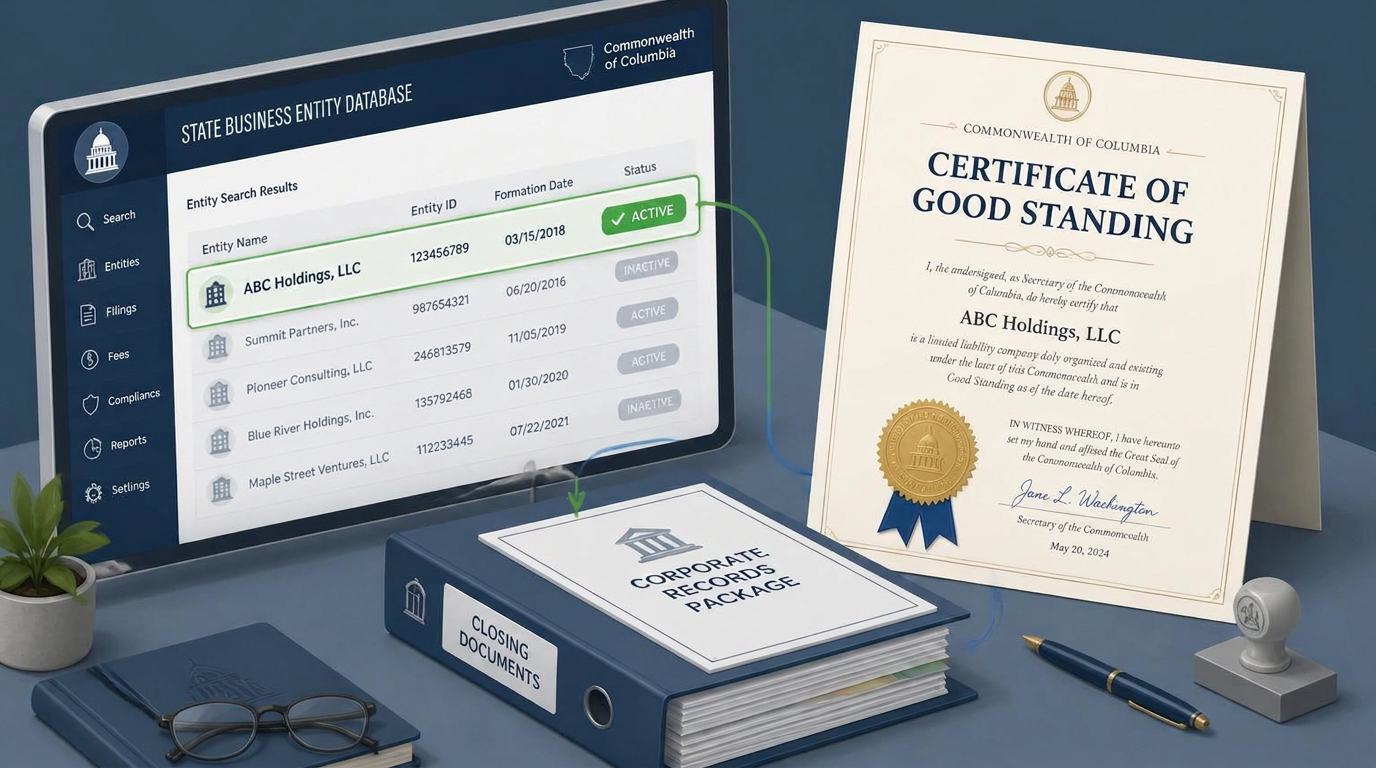
When a bank, credit union, or private lender is closing a commercial loan to a legal entity, two terms appear in closing checklists almost interchangeably: active status and good standing. Many teams treat them as synonyms. They aren't, and the conflation creates a category of closing-day surprises that the right pre-closing check could have caught for under two dollars.
The distinction, briefly
Active status is a fact the state's filing authority maintains in its database in real time. An LLC or corporation is either active or it isn't. If the entity has been dissolved, suspended, or administratively voided, the database reflects that. The check is binary, and answers the foundational pre-closing question: does this entity currently have the legal capacity to take a loan?
A certificate of good standing is a different thing. It's a formal document the state issues — sometimes called a certificate of existence or certificate of status — attesting to facts as of the date the certificate is dated. Most certificates confirm the entity exists and is authorized to transact business. Many add that the entity is current on annual reports and franchise tax. So a certificate is active status plus, depending on the state, some bundle of compliance attestations. And it's an artifact: dated, sealed, signed, suitable for a closing binder.
The two overlap (a current certificate includes the active fact), but they're built for different jobs. The active check is an operational verification the lender runs on a cadence. The certificate is a documentary record someone else will inspect.
Why the early check matters
The cheapest version of this story is one where the lender catches an inactive borrower entity at application, before underwriting commits time, before the borrower has paid fees, before counsel has drafted anything. That's the leverage point.
Done manually, the leverage gets lost in friction. Each state runs its own filing portal with its own URL, search fields, and quirks, so checking active status across fifty states means keeping a running spreadsheet of state systems and clicking through a different process every time, then producing a one-page printout for the closing file. Lender operations teams do it, but they pay for it in hours.
An EntityScan Report at the loan application stage handles all of that directly. The Report is the comprehensive borrower-entity package — attorney-validated analysis of operating agreements, ownership chains, signature authority, and document anomalies, with a fifty-state active status check built in and run against both the formation state and the property state. If the entity isn't active in either, the Report surfaces that fact before anyone has invested time in the deal, and the lender can stop, pivot, or push the borrower to cure.
Every EntityScan Report ships with a separate detailed status check PDF the lender can drop into the closing file — full state-returned detail plus links to filed documents where states publish them. Short of a state-issued certificate of good standing, it's a written due diligence artifact that's as close as a lender can get.
Should you also order a certificate of good standing?
That depends entirely on what the certificate is for. And the decision starts with active status, not the other way around.
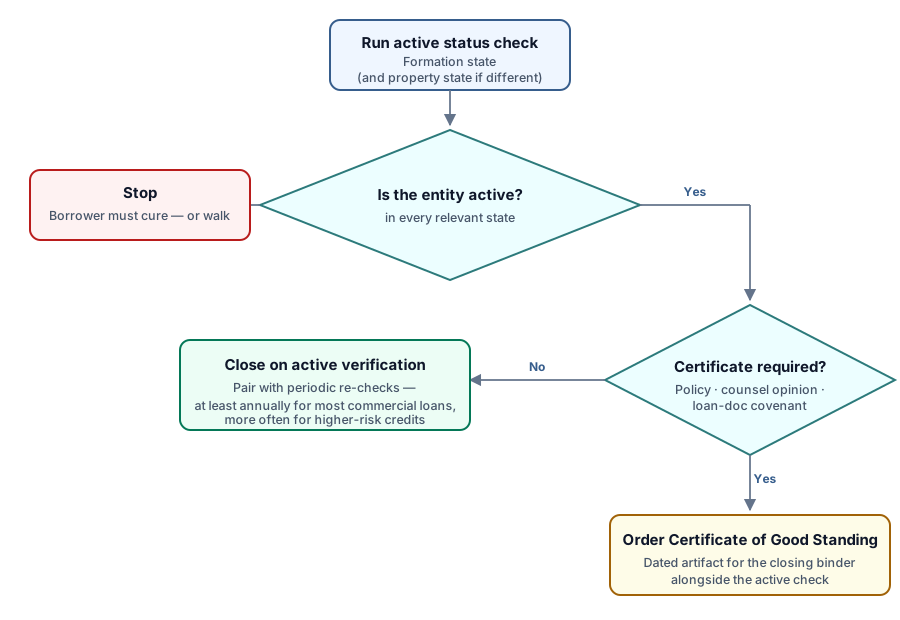
If the entity isn't active, there's no certificate to order. The state won't issue one for a dissolved entity, and the deal stops at the active-check step until the borrower cures or the lender walks. If the entity is active, the certificate question turns on three things:
- Lender policy. Many lenders require a certificate on every loan as a matter of credit-administration or compliance policy. Most common at banks selling into the secondary market, credit unions running participation programs, and debt funds operating on warehouse lines, where investors and counterparties expect a certificate in the closing binder.
- Counsel-opinion backup. Where borrower counsel opines that the entity is duly organized and in good standing, the certificate is the documentary evidence the opinion relies on.
- A loan-document covenant. Conditions precedent, anniversary requirements, draw conditions on revolvers — some loan documents make the certificate non-optional regardless of policy.
Absent one of those, many private lenders, bridge lenders, and smaller credit unions close on active verification alone. That's a defensible position. An entity that's active at closing has the legal capacity to transact at that moment, and a certificate doesn't change what active status already certifies. It adds attestations about compliance issues that haven't yet reached the state's threshold for action. Paired with a periodic post-closing re-check (at least annually for most commercial loans, more often for higher-risk credits), an active-only workflow functions as an ongoing risk control rather than a one-time snapshot.
For periodic re-checks, EntityScan's Stand-Alone Status Check runs the same check and provides a PDF record at a nominal cost.
The remaining risk is documentary. A certificate speaks to the date it's issued; it can't certify status as of an earlier closing date. So if the loan later goes to sale, participation, or refinance and a buyer asks for the closing binder, a missing certificate can't simply be ordered after the fact.
EntityScan AI delivers a comprehensive borrower-entity Report — including a fifty-state active status check — at the loan application stage, catching entity issues before they create closing-day risk. For more on the document-level provisions lenders miss in operating agreements, see Signed, But Not Binding: The LLC Provisions Lenders Miss.
This article is general information for lending professionals and is not legal advice. Consult counsel on specific transactions.
Gary Highland is the Founder & CEO of EntityScan AI